Published on · Updated on
Brow lift: the complete guide to eyebrow lift surgery
Contents
- What is a brow lift?
- Who is a brow lift for?
- What are the brow lift techniques?
- How many millimetres does a brow lift raise the eyebrow?
- How does a brow lift go, step by step?
- What are the risks of a brow lift?
- Brow lift or blepharoplasty: which one?
- How much does a brow lift cost, and is it reimbursed?
- Brow lift: frequently asked questions
- Key takeaways
- Study your project
Brow lift explained: what an eyebrow lift does, who it suits, the techniques, how many millimetres you gain, 5 to 20 days of recovery and the risks.
 By the Medi’Go team · · Reviewed by Dr Beya Bouricha
A brow lift (eyebrow lift, or forehead lift) raises drooping eyebrows and softens forehead lines, for a more open look and a less tired face. The most common version is endoscopic: 3 to 5 small incisions of 5 to 10 mm hidden in the hair, 45 to 90 minutes of surgery, 5 to 20 days before normal life resumes and a final result judged at 3 to 6 months. This guide relies on the French plastic surgery society’s patient leaflet and on two scientific reviews from 2026, and it also says what the operation does not promise.
“Brow lift” is the term most people use, but you will also read eyebrow lift, forehead lift and frontotemporal lift: they are procedures of the same family, working on the upper third of the face. Here is what to know before discussing it with a surgeon.
What is a brow lift?
A brow lift corrects flaws of the forehead and temples, hereditary or caused by age. The surgeon repositions the tissues that support the eyebrows and weakens the muscles responsible for wrinkles. For the French society of plastic surgery (SOF.CPRE), endoscopy found its best use here: a mini camera and special instruments allow the operation through small incisions, which minimises surgical trauma and considerably reduces scars.
It mainly targets four things: a sagging forehead with horizontal lines, low eyebrows with excess skin on the upper eyelids, the frown lines between the eyebrows and the crow’s feet at the corner of the eyes. The aim, according to the society, is to replace a “tired” or “severe” look with a fresher, more relaxed appearance and a more open gaze.
- The 3 to 5 incisions of 5 to 10 mm sit in the scalp, a few centimetres behind the hairline: the future scars are hidden.
- One of them lets the endoscope, linked to a mini camera, pass through; the others take the instruments.
- The forehead and temples are released down to the brow ridges, then the tissues are put back under tension and fixed higher.
Who is a brow lift for?
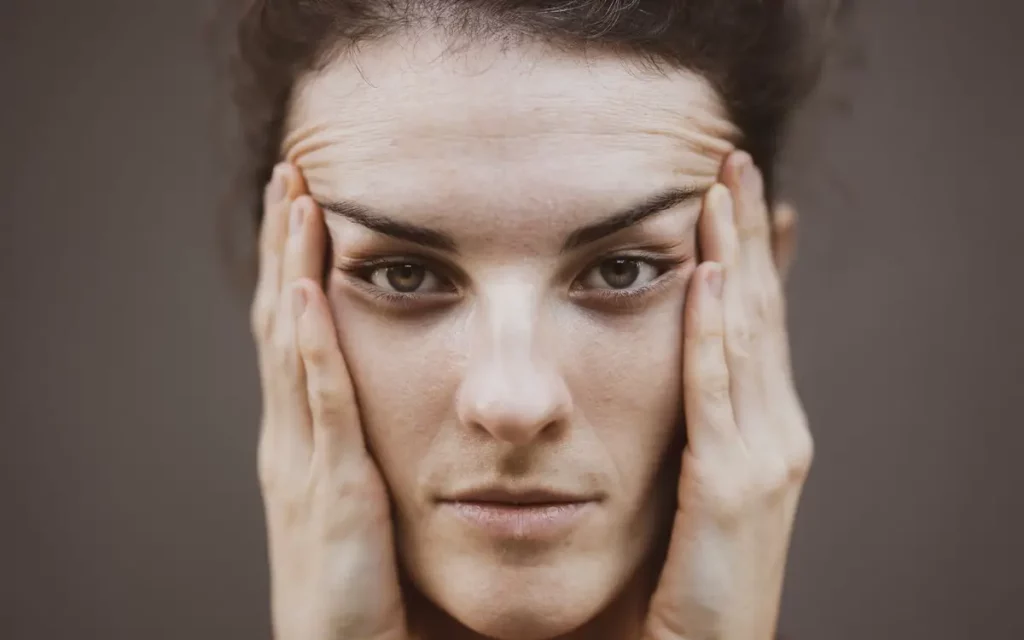
The operation is performed on women and men, from 40 onwards except in special cases. It is sometimes offered earlier when the flaws are constitutional: eyebrows that were low to begin with, or early frown lines caused by overactive muscles.
What a brow lift can correct
- Eyebrows that sag
- A forehead that drops, with horizontal lines
- Frown lines between the eyebrows
- Crow’s feet
- Excess skin caused by a low eyebrow
What it does not do
- It does not stop ageing
- It softens wrinkles without erasing them completely
- It does not replace eyelid surgery if excess skin remains
- It is not covered by health insurance
Smoking matters: the SOF.CPRE strongly recommends stopping at least one month before and one month after the operation, because it can delay healing and increases the risk of healing problems, skin necrosis and localised hair loss.
What are the brow lift techniques?
Each surgeon adapts the technique to each case. A systematic review published in 2026 (15 studies, including 4 randomised trials) sorts them into three families.
| Family | Examples cited | What the studies say |
|---|---|---|
| Endoscopic | Endotine fixation, concentric cable, cortical tunnel | Fewer scars, faster recovery and fewer complications than open techniques; minor complications generally under 5%. |
| Open | Coronal, direct, frontotemporal, internal browpexy | More visible scar. May remain suitable for advanced eyebrow drooping. |
| Minimally invasive | Gliding brow lift, endoscopic mesh, limited incision without endoscope | Described as quicker, with a very short recovery for the gliding brow lift; data are more limited. |
The authors call for better standardised studies: samples are small and outcomes are reported in different ways. What to remember is that endoscopy is the reference technique described by the SOF.CPRE for the forehead and temples, and that it requires specific training.
How many millimetres does a brow lift raise the eyebrow?
This is the question that general-audience leaflets avoid. A systematic review of 17 studies (Atiyeh et al., 2026) measured the average eyebrow elevation at three points: above the inner corner of the eye, the middle of the pupil and the outer corner.
- Above the inner corner of the eye.
- Above the middle of the pupil.
- Above the outer corner of the eye.
Average eyebrow elevation after a lift
In millimetres, pooled average across the studies in the review
Source : Atiyeh et al., 2026
In other words: a few millimetres, not centimetres. In the included studies, the highest elevation maintained over the long term did not exceed 5.6 mm.
A successful brow lift is counted in millimetres: it reopens the eyes, it does not change the face.
And over time? For endoscopic techniques (15 of the 17 studies), the elevation is maintained beyond one year, with a gradual loss: one study followed for more than five years reports a drop of about 1 mm a year at the middle of the eyebrow. The authors conclude that neither open nor endoscopic lifts hold the elevation very well over the long term, especially at the outer side, and that the shape of the eyebrow matters more than its height. The SOF.CPRE, for its part, states that results are generally lasting and that the benefit is felt for several years, without stopping ageing. The two messages agree: a benefit that lasts, but is neither frozen nor permanent.
How does a brow lift go, step by step?
Before the operation, the surgeon analyses your request and studies the forehead and temple area in relation to the rest of the face. The anaesthetist sees you in consultation at least 48 hours beforehand. Two kinds of anaesthesia are possible: deep local anaesthesia with tranquillisers (“twilight”) or general anaesthesia, chosen with the surgeon and the anaesthetist.
The operation is often done as a day case, with discharge the same day after a few hours of monitoring. A short stay with one night on site is sometimes preferable.
- 10 days beforeNo more medicines containing aspirin. Stopping smoking is advised at least one month before. You stay fasting according to the anaesthetist’s instructions.
- Day of surgeryIncisions in the scalp, release of the forehead and temples, weakening of the wrinkle muscles, repositioning under tension, then deep fixation. Closure with staples or absorbable stitches. Allow 45 to 90 minutes.
- Days 1 to 3The dressing comes off between day 1 and day 3 depending on the surgeon. Swelling, bruising and a feeling of tightness in the forehead, temples and eyelids: rest, no strenuous effort.
- Days 8 to 15The staples are removed between day 8 and day 15.
- 5 to 20 daysReturn to normal social and working life, depending on how marked the after-effects are.
- First weeksSome numbness of the forehead and a little itching of the scalp may appear. They fade gradually.
- 3 to 6 monthsThe final result can be judged: the swelling has gone and the tissues have regained their suppleness.
- From month 6If an imperfection is hard to live with, a small touch-up is usually done under simple local anaesthesia.
What are the risks of a brow lift?
Even when done for aesthetic reasons, it is a real surgical operation, with the risks of any medical procedure. The SOF.CPRE states that true complications are exceptional after an endoscopic lift performed properly.
Most often harmless, it is drained if it is too large. Not to be confused with bruising, which is normal after the operation.
Numbness and itching of the forehead or scalp may appear. They fade after a few months.
Paralysis is much rarer and, in most reported cases, temporary.
Healing problems, skin necrosis and localised hair loss are rare and more discreet than with a classic lift, but smoking increases the risk.
Swelling that lasts a few months, slight eyebrow asymmetry, return of some frown lines: it settles by itself or is touched up from month 6.
Exceptional under normal sterile conditions, and always local.
The 2026 review points the same way: across 15 studies no major complication was observed, minor complications (relapse, temporary numbness, tenderness) are reported in 13 of them, and rates for endoscopy are generally under 5%. One study does report a permanent paraesthesia in its endoscopic group.
Another point raised by the authors of the second review: endoscopy has a long learning curve. It is one more reason to choose a qualified plastic surgeon trained in this technique, as the SOF.CPRE reminds patients.
Brow lift or blepharoplasty: which one?
A sinking eyebrow pushes skin down onto the upper eyelid and gives a heavy look. In that case it is the eyebrow that is raised: the SOF.CPRE lists among the targets of the lift the sagging of the eyebrows with excess skin on the upper eyelids. If the excess skin belongs to the eyelid itself, it is blepharoplasty, eyelid surgery, that treats it.
- A low eyebrow weighing on the eyelid: the eyebrow is raised (brow lift).
- Eyebrow well placed but excess skin on the eyelid: blepharoplasty.
- Both at once: combined procedures, decided by the surgeon. After a lift, excess skin on the eyelid may call for an additional excision.
The brow lift is often combined with other facial procedures: blepharoplasty, canthopexy (lifting the corner of the eyes), cervicofacial lift, laser, peeling or botulinum toxin. If your project involves the whole face and neck, read our page on the facelift in Tunisia.
Do not confuse them. A lift raises eyebrows that already exist. For sparse or missing eyebrows, the answer is an eyebrow transplant, a different operation.
How much does a brow lift cost, and is it reimbursed?
No: aesthetic surgery is not covered by health insurance, according to the SOF.CPRE and the CHUV. The cost depends on the procedure (alone or combined with blepharoplasty or a facelift), the anaesthesia and the clinic. It is set in a written quote, after your file has been studied.

Many patients from France, Belgium and Switzerland compare with Tunisia. To understand where the gap comes from without giving up anything on safety, read why cosmetic surgery costs less in Tunisia, then what to do if a complication occurs once you are back home. At Medi’Go the process is simple:
- You send your photos on WhatsApp or through the quote form.
- A Medi’Go adviser replies in French, free of charge and without commitment.
- A partner surgeon studies your file and says whether the operation is feasible.
- You receive a written quote detailing each service.
Brow lift: frequently asked questions
Are a brow lift and a forehead lift the same thing?
They are procedures of the same family, working on the forehead, temples and eyebrows. In French the usual term is lifting du front or lifting des sourcils; the SOF.CPRE leaflet speaks of an endoscopic frontotemporal lift.
Surgical brow lift or salon brow lift: what is the difference?
In a beauty salon, “brow lift” means a cosmetic treatment of the brow hairs, which are set and fixed upwards, with no incision or anaesthesia: it does not raise the brow itself and its effect is temporary. This guide is about the surgical brow lift, which raises the brow and the forehead.
From what age can you have a brow lift?
From 40 onwards except in special cases, in women and men alike. The operation may be offered earlier if the eyebrows have always been low or if frown lines appeared early.
Is a brow lift painful?
There is no real pain, but some discomfort and a feeling of tightness in the forehead, temples and eyelids. Swelling and bruising are the main after-effects.
When can you go back to work after a brow lift?
After 5 to 20 days depending on how marked the after-effects are, according to the SOF.CPRE. The dressing comes off between day 1 and day 3, the staples between day 8 and day 15.
Can you see the scars of an endoscopic brow lift?
The incisions measure 5 to 10 mm and sit in the scalp, a few centimetres behind the hairline, so they are almost invisible. An open lift leaves a more visible scar.
Is the result of a brow lift permanent?
It is lasting but not frozen. The final result is judged at 3 to 6 months and the benefit is felt for several years. Studies do measure a gradual loss of elevation, about 1 mm a year in a study followed for more than five years.
Is a brow lift reimbursed?
No. It is aesthetic surgery, which is not covered by basic health insurance.
Key takeaways
A brow lift raises the eyebrows by a few millimetres, softens forehead lines and reopens the gaze. The endoscopic technique, with its small hidden incisions, is the reference; it calls for a trained surgeon, 5 to 20 days of recovery and a result judged at 3 to 6 months. It lasts, without stopping ageing. Depending on the position of the eyebrow and the state of the eyelids, it is combined or not with blepharoplasty.
Study your project
Want to know whether a forehead or eyebrow lift suits you? Fill in the personalised quote form: a Medi’Go adviser calls you back, then a partner surgeon studies your file and confirms whether the operation is feasible. The final quote details every service. No commitment is asked at this stage.
This article is general information and does not replace a medical consultation.
Sources
- Société Française de Chirurgie Plastique Reconstructrice et Esthétique, patient leaflet “Lifting fronto-temporal endoscopique”, version 4, updated November 2013 (in French) — view
- Plastic and hand surgery department, CHUV (Lausanne), patient leaflet “Lifting fronto-temporal” (in French) — view
- Alabdulkarim A. et al., Comparative Outcomes of Traditional Versus Endoscopic Brow Lift Techniques: A Systematic Review, Plastic and Reconstructive Surgery Global Open, 2026;14(2):e7477 — view
- Atiyeh B. S. et al., Forehead Eyebrow Lift Techniques: Review of the Literature and Critical Appraisal of Long-term Efficacy, Plastic and Reconstructive Surgery Global Open, 2026;14(3):e7578 — view
- Sources consulted on 3 November 2026.
Photo credits: Shiny Diamond, Engin Akyurt, Yusuf Çelik, cottonbro studio (Pexels).
Medi’Go organises cosmetic surgery stays in Tunisia: partner clinics, airport pick-up, and follow-up before and after the procedure.
Reviewed by Dr Beya Bouricha, physician trained in hair transplantation and anti-ageing medicine
Read also
Send your photos, we reply in your language
Free, confidential assessment by a Medi’Go adviser, then the surgeon’s opinion and a written quote, no obligation.