Published on · Updated on
PCOS and hair loss: figures, diagnosis, minoxidil, spironolactone and timelines
Contents
- PCOS and hair loss: how common is it?
- Why androgens thin the hair, and what PCOS hair loss looks like
- Hair loss alone: is it PCOS? What the international guideline says
- Which tests to ask for when hair falls with PCOS
- Treating PCOS-related hair loss: what is recommended, what is proven
- How long before you see an effect? Timelines
- PCOS, pregnancy and contraception: safety points
- Hair transplant and PCOS: when to consider it?
- PCOS and hair loss: frequently asked questions
- Key takeaways
Does PCOS cause hair loss? What the 2023 international guideline and the studies say: how common it is, testing, the pill, spironolactone, minoxidil, timelines, pregnancy and hair transplant.
 By the Medi’Go team · · Reviewed by Dr Beya Bouricha
PCOS can come with androgenetic hair loss: a 2025 meta-analysis (18 studies, 3,464 women) found 22.7% of women with PCOS had this type of hair loss, with low-certainty evidence. But hair loss alone does not diagnose PCOS: the 2023 international guideline ranks it as a weak predictor. The options discussed are the pill, anti-androgens such as spironolactone (never to be taken without effective contraception if pregnancy is possible) and minoxidil, whose label asks for at least 4 months of use before judging.
This guide starts with the figures, explains how not to confuse PCOS with another cause, presents each treatment with what the guideline and the drug labels say, then gives timelines and safety points. The other triggers have their own guides; we link to them.
PCOS and hair loss: how common is it?
The figure depends on the study. Rayner’s 2025 meta-analysis pools 18 cross-sectional studies: 22.7% of women with PCOS had female pattern hair loss, but with very serious inconsistency between studies, which lowers the certainty to “low”. In the other direction, 32.3% of women with female pattern hair loss had PCOS (a very wide interval, 13.6 to 59.1%), with very low certainty.
Skin signs in 100 women with PCOS (%)
Cross-sectional study of 100 women aged 20 to 40, Srinagar (India)
In this Indian study, hair loss therefore comes after hirsutism and acne. The meta-analysis remains observational: it shows an association, not a cause, and the authors note possible underdiagnosis of both PCOS and hair loss. The data also do not say whether a woman with PCOS loses hair faster than another woman.
Why androgens thin the hair, and what PCOS hair loss looks like
In the scalp, testosterone is converted by the enzyme 5α-reductase type 2 into dihydrotestosterone (DHT), which binds to receptors in the cells of the dermal papilla: the growth phase of the hair shortens and the follicle shrinks. According to a 2026 review, insulin resistance, low-grade inflammation and genetic variants may make follicles more sensitive to androgens, which would explain why the blood level alone is not enough: many women with moderate to severe hair loss have normal total androgens. The authors present several of these mechanisms as hypotheses, partly based on preclinical work.
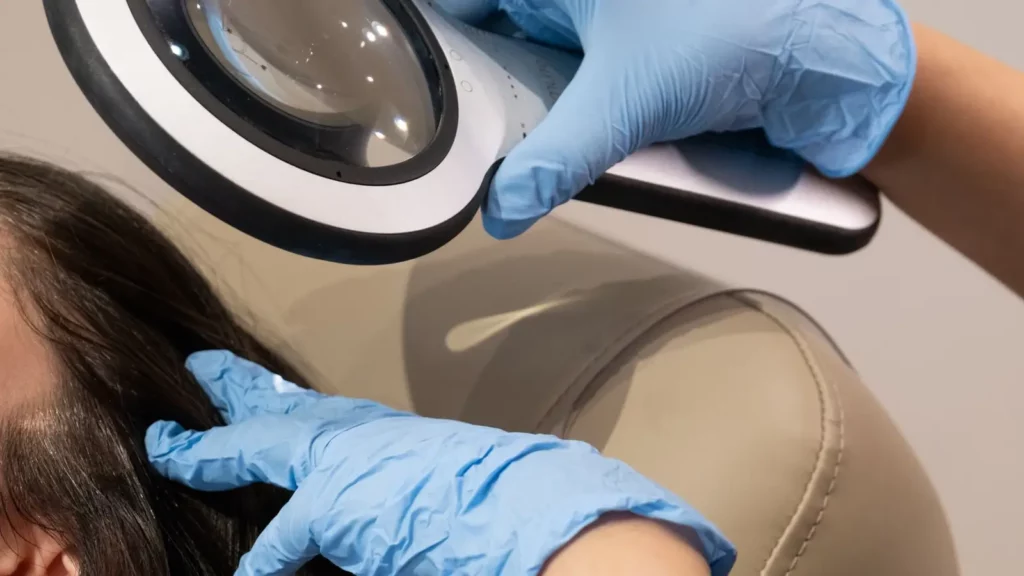
On examination, the thinning is diffuse over the crown and the mid-frontal scalp, with the frontal hairline usually preserved; the part widens at the top. Ludwig’s scale describes three stages: early thinning (I), visible scalp (II), sparse hair on the crown (III). In the same review, the available treatments more often slow or stabilise hair loss than reverse the shrinking of the follicle.
Hair loss alone: is it PCOS? What the international guideline says
The 2023 international guideline (Teede et al.) separates what points to PCOS from what is not enough:
| Sign | What the guideline says | Reference |
|---|---|---|
| Hirsutism (thick, dark hair in male-pattern areas) | On its own, it predicts hyperandrogenism in adults | 1.3.1 |
| Hair loss or acne without hirsutism | These are weak predictors of biochemical hyperandrogenism | 1.3.2 |
| Female pattern hair loss in the history and examination | To be looked for systematically | 1.3.3 |
| A complaint of hair loss | To be treated as important, whatever the apparent severity | 1.3.4 |
| Contraceptive pill | It interferes with androgen testing: stop for at least 3 months if testing is essential | 1.2.6 |
In other words, a widening part with regular cycles and no hirsutism is not the signature of PCOS. Conversely, the guideline asks that the complaint be taken seriously even when the loss looks modest. If you take the pill, it can mask the hormone tests: it is for the doctor to decide whether to stop it before testing.
- Note how regular your cycles are and whether you are on the pill, with dates.
- Have a doctor examine the scalp and body hair (hirsutism, acne): these are the signs that weigh the most.
- Rule out the other common causes: the thyroid, iron, a recent diet or a delivery.
- Ask the doctor whether androgen testing is useful and when to do it relative to the pill.
- Take dated photos of the part and temples, in the same light, to track progress.
Hair loss does not prove PCOS, and PCOS cannot be judged from hair loss alone.
Which tests to ask for when hair falls with PCOS
| Test | What it is for | Reference |
|---|---|---|
| Scalp and body examination (Ludwig or Sinclair scale; hirsutism, acne, acanthosis nigricans) | Stages the hair loss and looks for signs of excess androgens | 2026 review; recommendations 1.3.1 to 1.3.4 |
| Total and free testosterone, androstenedione, DHEAS | Look for excess androgens; the pill skews the result (stop for at least 3 months if testing is essential) | 2026 review; recommendation 1.2.6 |
| Fasting glucose and insulin, HOMA-IR, lipids | Assess the metabolic side of PCOS | 2026 review |
| TSH, ferritin, prolactin | Rule out other causes of hair loss | 2026 review |
| Scalp biopsy | Rarely needed: separates androgenetic alopecia from scarring alopecia | 2026 review |
Hormone levels do not always reflect what happens in the follicle: according to the authors of the 2026 review, the blood measurement is sometimes an unreliable marker of scalp androgen activity. The doctor decides which tests are useful; do not change your pill before a test without their advice.
Treating PCOS-related hair loss: what is recommended, what is proven
There is no single treatment. The 2023 guideline mainly addresses hirsutism and cycles; for hair loss it makes a cautious consensus recommendation. Here is what the sources say:
Recommended in adults of reproductive age with PCOS for hirsutism and/or irregular cycles (recommendation 4.2.1). It interferes with androgen testing (1.2.6).
For hair loss, a trial in combination with the pill can be considered, but PCOS-specific evidence is limited (consensus recommendation 4.6.2). Before that, 6 months of the pill or cosmetic therapy for hirsutism (4.6.1).
The guideline’s hair-loss recommendation (4.6.2) concerns anti-androgens and does not address minoxidil. In a trial of 381 women, the 5% and 2% solutions beat placebo on hair count at 48 weeks.
The guideline targets them at facial hirsutism (4.8.1), not hair loss; laser is relatively ineffective on blond, grey or white hair (4.8.4).
| Treatment | What the sources say | Safety point |
|---|---|---|
| Spironolactone (anti-androgen) | A dose of 25 to 100 mg a day appears to have lower risks of adverse effects (practice point 4.6.5) | The label asks to avoid it in pregnancy (risk of feminization of a male fetus) and to monitor potassium within a week of starting; irregular periods are reported |
| Cyproterone acetate | Doses of 10 mg and above are not advised (4.6.5); the 35 µg ethinylestradiol combination is a second-line option (4.2.5) | Increased risk, including meningioma, at doses of 10 mg and above |
| Finasteride | The guideline gives no efficacy or dose recommendation | Increased risk of liver toxicity (4.6.5) |
| Minoxidil 2% (women’s solution, US label) | 1 mL twice a day on the thinning area; at least 4 months before seeing results | May be harmful in pregnancy or breastfeeding; stop and report if the scalp is irritated or red |
In the Lucky trial (2004), 381 women received minoxidil 5% (153), 2% (154) or placebo (74) for 48 weeks: both strengths beat placebo on hair count, and the 5% solution was rated more beneficial than 2% by patients, at the price of more itching, irritation and facial hair. The trial enrolled women with female pattern hair loss, not specifically PCOS.
A 2026 network meta-analysis compares 15 non-surgical treatments for female pattern hair loss across 14 trials (919 patients): spironolactone plus minoxidil ranks 4th, topical minoxidil alone 11th, but certainty is “low to very low”, there is no placebo arm, and the authors do not recommend the top-ranked combination (microneedling plus minoxidil) as first-line. A ranking is therefore not a prescription.
Other options cited by the same review: platelet-rich plasma (PRP) injections improve density and thickness in randomized trials and meta-analyses, but in small samples with varying protocols, and few trials concern PCOS; low-level laser has low to moderate efficacy and needs prolonged use; mesotherapy gives variable results with no standard protocol. Iron, vitamin D and zinc are advised only when a deficiency is documented.
How long before you see an effect? Timelines
- From the start of spironolactoneThe label asks for a potassium check within a week of starting or increasing the dose, then regularly.
- 4 monthsMinimum use of minoxidil 2% twice a day before expecting a result, according to the US label.
- 6 monthsDuration of the pill and/or cosmetic therapy before considering an anti-androgen for hirsutism (recommendation 4.6.1): a benchmark for hirsutism, not for hair.
- 48 weeksLength of the Lucky trial: this is the horizon at which minoxidil’s advantage over placebo was measured.
- When minoxidil is stoppedThe label states that hair loss resumes if you stop: the effect lasts only while treatment continues.
The 2023 guideline states that evidence for hair loss is limited, and the studies cited give no regrowth time after anti-androgen treatment in PCOS. A monthly photo log remains the best benchmark.
PCOS, pregnancy and contraception: safety points
Points to know before starting
- If pregnancy is possible, an anti-androgen requires effective contraception: the guideline strongly advises effective contraception and counselling about the risk to a male fetus (4.6.3)
- Spironolactone requires a potassium check within a week of starting (label)
- Topical minoxidil may be harmful in pregnancy or breastfeeding (label)
- The pill interferes with androgen testing: tell the doctor before any hormone test (1.2.6)
To avoid
- Taking spironolactone when pregnancy is possible without effective contraception
- Using finasteride or cyproterone acetate without medical advice, because of liver risk and meningioma
- Stopping or changing the pill on your own before a hormone test
- Using more minoxidil than the dose: “using more or more often” does not improve results (label)

Hair transplant and PCOS: when to consider it?
A hair transplant moves follicles; it does not treat hyperandrogenism or the irregular cycles of PCOS. It is only discussed after testing, a diagnosis of female pattern hair loss made by a doctor and a medical treatment already tried. If that is your case, send us your photos: a partner surgeon will study your file. Page to read: hair transplant for women; for a figure, a personalised quote.
Before that, check the neighbouring causes: the thyroid and a recent diet, which we detail in their guides, as well as the effect of the contraceptive pill on hair.
What these sources do not say. They give no regrowth timeline on treatment in PCOS; the frequency studies are observational, with low to very low certainty; the minoxidil trial was not specific to PCOS; the guideline’s hair-loss recommendation (4.6.2) concerns anti-androgens and does not address minoxidil. The decision to treat belongs to the doctor.
PCOS and hair loss: frequently asked questions
Does PCOS cause hair loss?
It can come with androgenetic hair loss: 22.7% of women with PCOS in a meta-analysis of 18 studies, 31% in a study of 100 women. The certainty is low and it is an association, not a proven cause.
Is hair loss enough to diagnose PCOS?
No. The 2023 international guideline ranks hair loss or acne without hirsutism as weak predictors of biochemical hyperandrogenism. Hirsutism weighs more.
What treatment for PCOS hair loss?
The combined pill is recommended for hirsutism and cycles; an anti-androgen combined with the pill can be tried for hair loss, with limited evidence. Topical minoxidil beat placebo at 48 weeks in a trial that was not specific to PCOS.
Is spironolactone safe?
It requires a potassium check within a week of starting, and the label asks to avoid it in pregnancy. The guideline requires effective contraception if pregnancy is possible. It must be prescribed by a doctor.
How long does minoxidil take to work?
The US label for minoxidil 2% asks for at least 4 months of use, twice a day. In the Lucky trial, results were measured at 48 weeks.
What happens when you stop minoxidil?
The label states that hair loss resumes when you stop: treatment must continue to keep the effect.
Can the pill skew PCOS tests?
Yes: the guideline says it interferes with androgen testing and advises stopping for at least 3 months if testing is essential. That is for the doctor to decide.
Can you have a hair transplant with PCOS?
A transplant does not treat the hormonal cause. It is discussed after testing, a diagnosis of female pattern hair loss and a medical treatment already tried.
When should you see a doctor for hair loss and PCOS?
If the part is widening, if cycles are irregular, if thick hair appears in male-pattern areas or acne, or if hair loss lasts or worsens. The guideline asks that the complaint be taken seriously whatever the apparent severity.
Can PCOS hair loss occur with normal testosterone?
Yes: according to a 2026 review, many women with moderate to severe hair loss have normal total androgens, sometimes near the upper limit, and the blood level reflects follicle-level activity poorly.
Is minoxidil 5% more effective than 2%?
In the Lucky trial, patients rated the 5% solution more beneficial than the 2% one, with more itching, irritation and facial hair. The 2026 review notes that the 5% foam did better than the 2% solution.
Which doctor should I see?
A dermatologist to examine the scalp, and a gynecologist or endocrinologist for the PCOS work-up. Do not change your pill before a hormone test without the doctor’s advice.
Does hair grow back when PCOS is treated?
Treatments more often slow or stabilise hair loss than reverse the shrinking of the follicle, according to the 2026 review. The studies cited here give no regrowth time in PCOS.
Key takeaways
PCOS comes with female pattern hair loss in about 22.7% of women according to a 2025 meta-analysis, with low-certainty evidence, but hair loss alone cannot diagnose it. The pill and anti-androgens are discussed with a doctor, spironolactone requires effective contraception and a potassium check, and minoxidil needs at least 4 months of use. The studies cited here do not quantify regrowth in PCOS. Do not change any treatment on your own, and see a doctor if hair loss lasts or worsens.
This article is general information and does not replace a medical consultation. Do not start, stop or change any hormonal or anti-androgen treatment without a doctor’s advice.
Sources
- Teede H. J. et al., Recommendations from the 2023 international evidence-based guideline for the assessment and management of polycystic ovary syndrome, J Clin Endocrinol Metab, 2023;108(10):2447-2469 · PMC10505534
- Rayner D. G. et al., Bi-directional association between female pattern hair loss and polycystic ovary syndrome: a systematic review and meta-analysis, JAAD International, 2025;23 · PMC12481967
- Keen M. A., Shah I. H., Sheikh G., Cutaneous Manifestations of Polycystic Ovary Syndrome: A Cross-Sectional Clinical Study, Indian Dermatol Online J, 2017;8(2):104-110 · PMC5372429
- Lucky A. W. et al., A randomized, placebo-controlled trial of 5% and 2% topical minoxidil solutions in the treatment of female pattern hair loss, J Am Acad Dermatol, 2004;50(4):541-553 · PMID 15034503
- Hu C. et al., Comparative Efficacy of Non-Transplant Interventions for Female Pattern Hair Loss: A Systematic Review and Network Meta-Analysis, J Cosmet Dermatol, 2026;25(7):e71037 · PMC13357034
- US Aldactone (spironolactone) label, DailyMed
- US Women’s Rogaine (minoxidil 2%, solution) label, DailyMed
- Motafeghi F., Saei Ghare Naz M., Ramezani Tehrani F., Behboudi-Gandevani S., Androgenetic alopecia in polycystic ovary syndrome: a cutaneous marker of systemic metabo-inflammatory and endocrine dysfunction, Endocr Connect, 2026 · PMID 42096403
- Sources consulted on 10 November 2026.
Medi’Go organises cosmetic surgery stays in Tunisia: partner clinics, airport pick-up, and follow-up before and after the procedure.
Reviewed by Dr Beya Bouricha, physician trained in hair transplantation and anti-ageing medicine
Read also
Send your photos, we reply in your language
Free, confidential assessment by a Medi’Go adviser, then the surgeon’s opinion and a written quote, no obligation.